
Artist Spotlight: Matthew Cordwell - Chasing Light
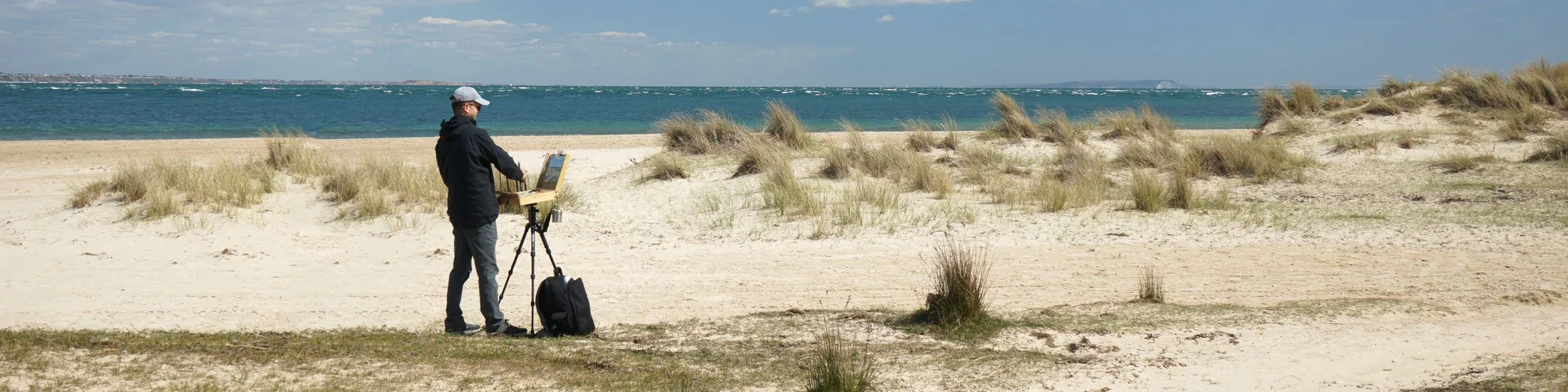
Matthew Cordwell
British landscape painter Matthew Cordwell works at the point where observation meets memory, capturing fleeting changes in light, weather and atmosphere through expressive oil painting.
There is something particular about a landscape painted in front of the landscape itself.
The weather changes. Shadows move. A cloud passes and suddenly the relationship between land and sky is completely different. Colours that seemed obvious ten minutes earlier disappear. Decisions have to be made quickly.
For British landscape painter Matthew Cordwell, this experience is central to the work.
Painting regularly en plein air, Matthew works directly within the countryside and coastline, responding to the shifting conditions around him. These encounters become intimate oil studies made on location and, at times, the starting point for larger works developed later in the studio.
What remains constant is a fascination with light and the way it can completely alter our experience of a place.
Painting from within the landscape
Matthew's paintings begin with looking.
Not simply at the shape of a field, a distant tree line or the curve of a path, but at everything happening around it: changing weather, the temperature of the light, movement through the sky and the subtle relationships between colours.
Working outside brings an immediacy that is difficult to reproduce from a photograph alone. The landscape is never entirely still and the painter has to decide what matters.
Matthew simplifies what he sees, allowing broad passages of colour, visible brushwork and instinctive marks to carry as much information as precise description.
The resulting paintings are recognisable landscapes, but they are not attempts to record every detail.
Instead, they hold onto something more elusive: what it felt like to be there.
When light becomes the subject
Across Matthew's work, the landscape often feels almost secondary to the light moving through it.
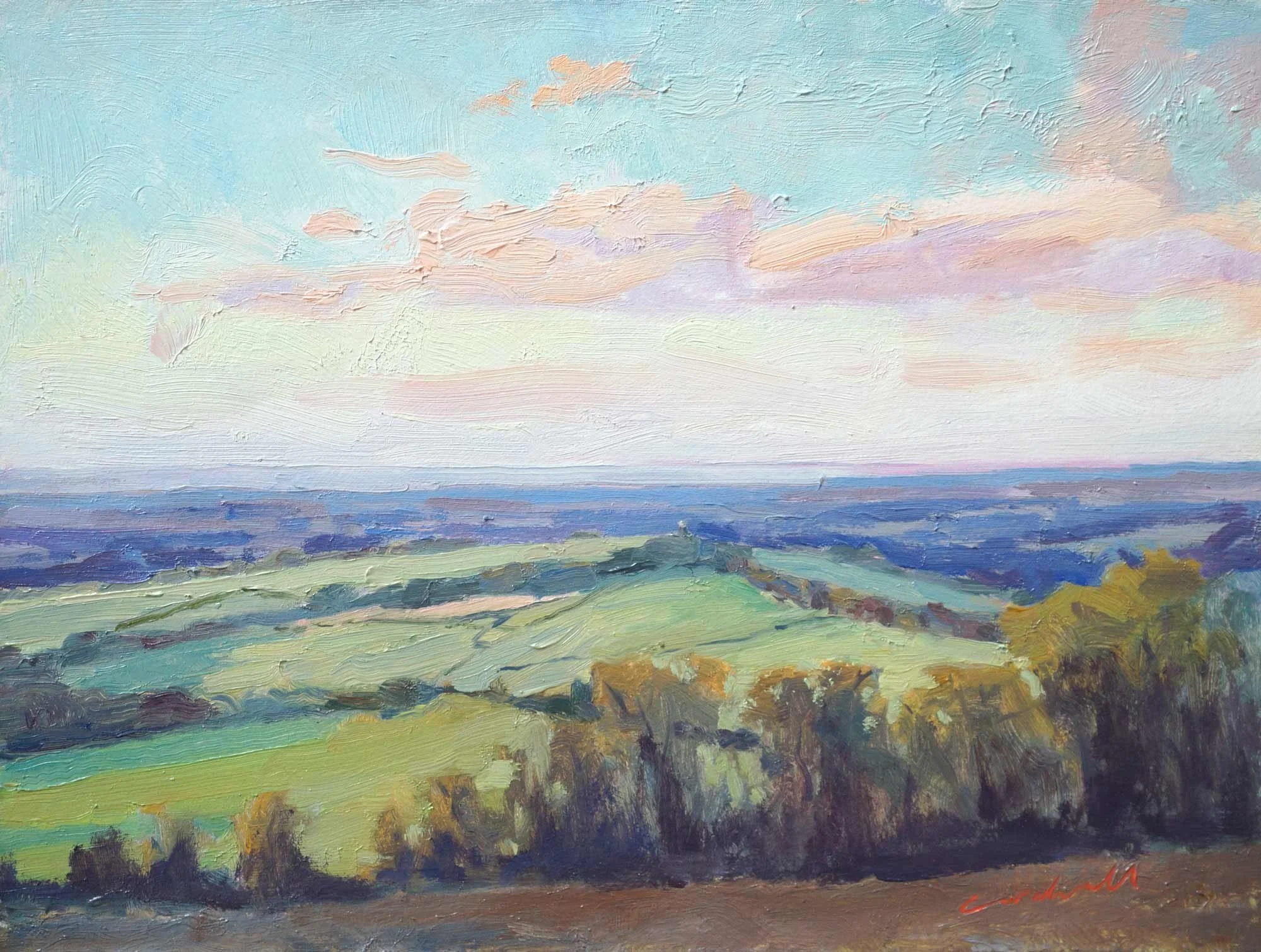
In Morning Glow, Goodwood, soft warmth appears to settle across the land, while Chasing Light captures that extraordinary moment when brightness moves through a landscape before disappearing again.
Elsewhere, the atmosphere becomes quieter.
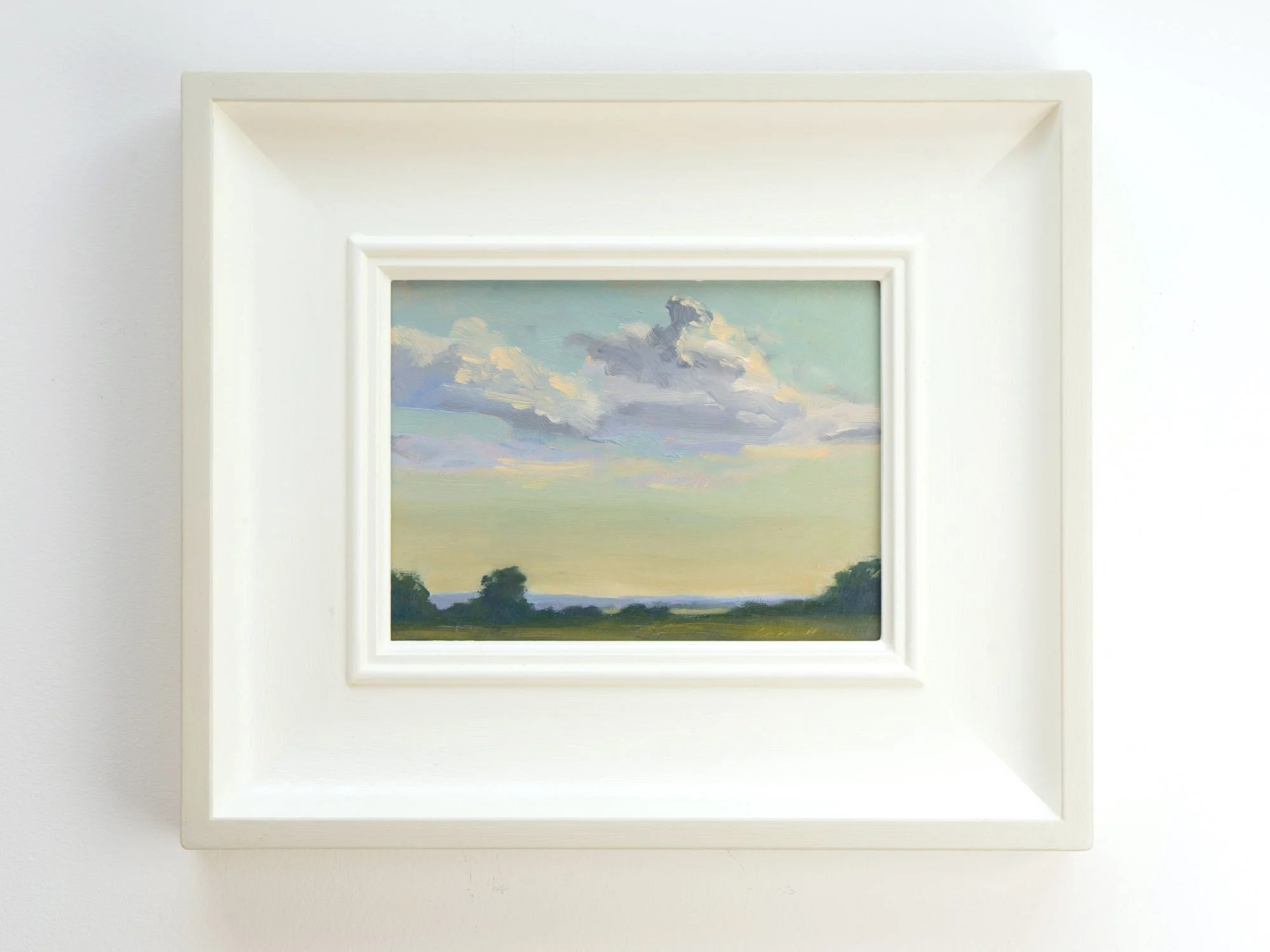
Evening's Final Whisper reduces the landscape to a small, contemplative moment at the end of the day, while Swept Skies gives considerably more of the composition to the movement above the horizon.
Even the titles suggest that these paintings are concerned with moments rather than permanent views.
Morning.
Evening.
A passing sky.
A patch of light.
They are observations of landscapes in transition.
Perhaps that is why they feel so familiar. We rarely experience a place as something completely fixed. What we remember is often a particular combination of weather and light: the way the sun suddenly appeared across a field, the colour of a sky before rain, or the extraordinary brightness of a winter afternoon.
Matthew's paintings give those temporary moments permanence.
The importance of painting small
There can be a tendency to associate presence in a room with scale.
Matthew's smaller paintings make a persuasive case for the opposite.
Many begin as direct studies made outdoors, where a relatively intimate surface allows decisions to remain immediate. There is little room for unnecessary information. A few carefully placed marks may describe an entire hillside. A sweep of colour can become a field; a broken brushstroke, a line of trees.
That economy gives the paintings an intensity that larger works do not always possess.
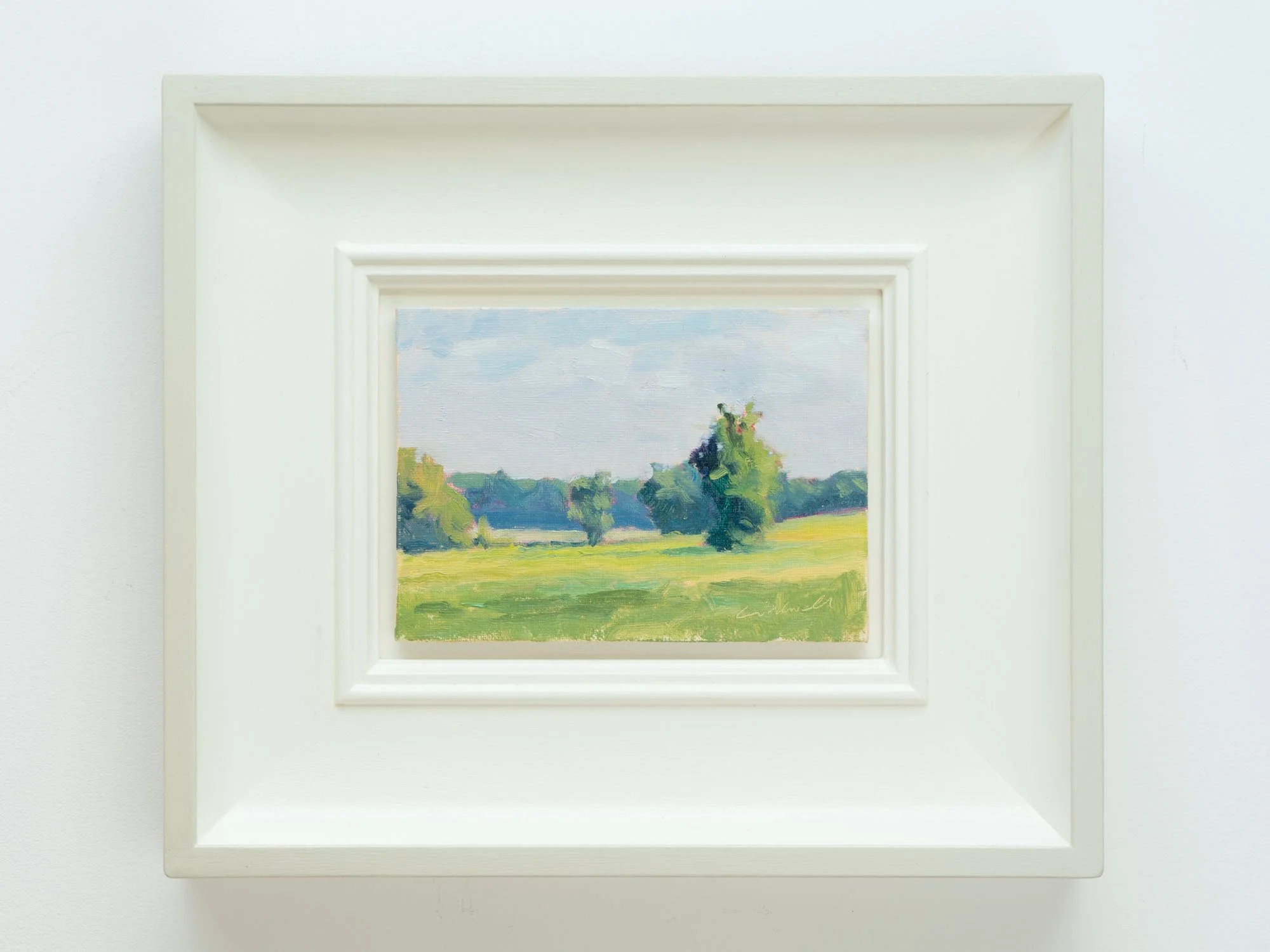
Harvest Light, Study, measuring just 18 × 13 cm before framing, is a particularly good example. The composition may be small, but the sense of distance within it is considerable.
There is something rather wonderful about that contradiction: a painting occupying relatively little physical space while opening up an entire landscape.
It also makes these works exceptionally versatile within an interior.
A small original painting does not need to fill a wall to command attention. It can sit above a bedside table, between windows, beside a bookshelf or as part of a collected wall of paintings and objects.
Equally, hung alone with enough space around it, a small landscape can become an unexpectedly powerful focal point.
Between observation and interpretation
Although Matthew's paintings are rooted in real places, increasingly the interest lies in what paint itself can do.
Edges dissolve.
Colour becomes heightened.
Marks remain visible.
A sky might be described through several broad movements of the brush rather than carefully blended into realism.
That space between recognition and abstraction is part of what gives the work its character.
We understand that we are looking at a field, coastline or distant horizon, but the painting never becomes simply an illustration of the place.
The physical act of painting remains visible.
Matthew's studio work develops this further. Experiences and studies brought back from the landscape can be revisited at a different pace, allowing compositions to become larger or more considered while retaining something of the initial encounter.
The aim is not to reproduce the plein air study exactly, but to carry its atmosphere forward.
Bringing landscape into an interior
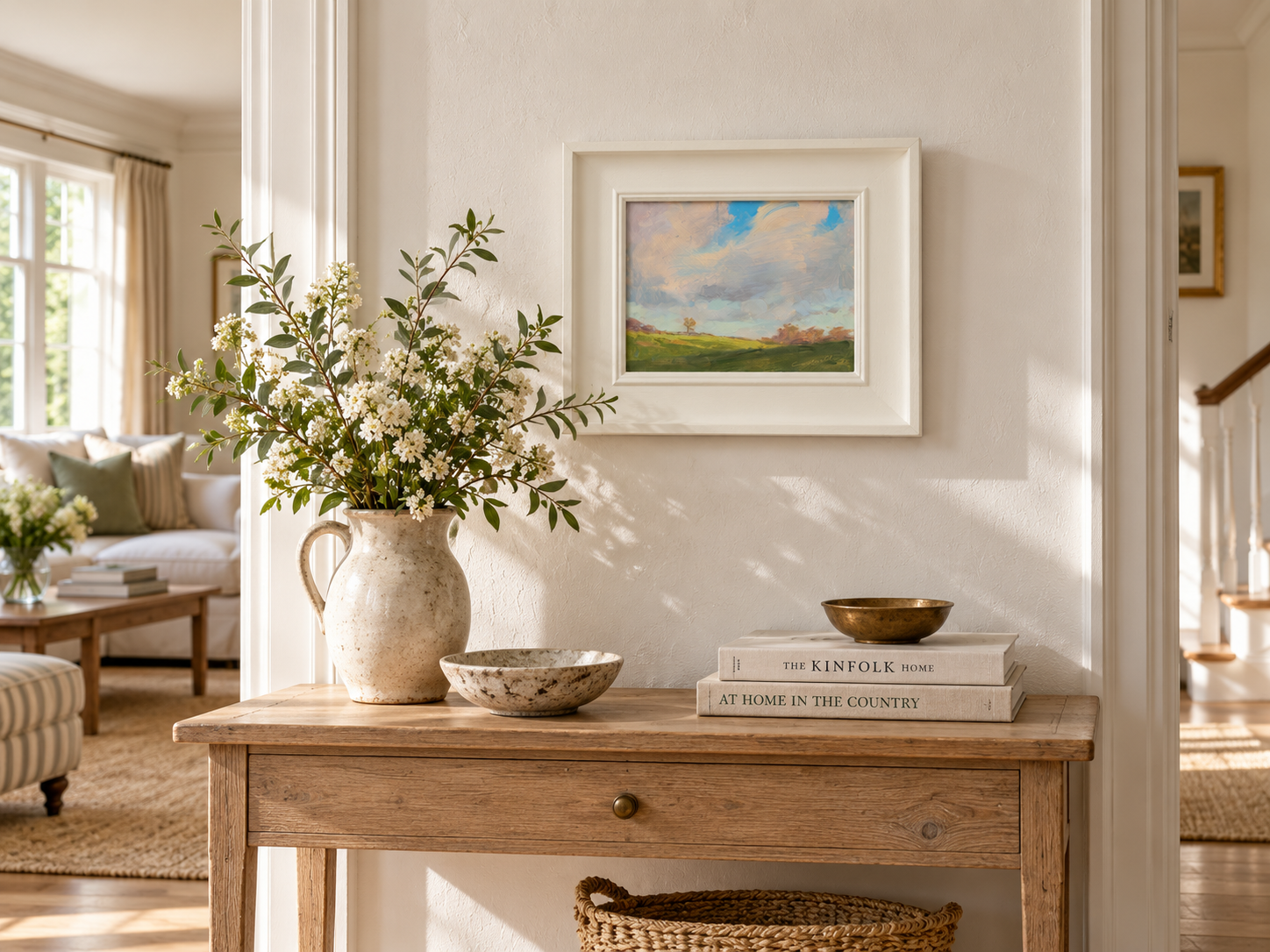
Landscape painting has an enduring relationship with the home, perhaps because it provides something that an interior cannot: distance.
A horizon draws the eye beyond the wall.
Open sky introduces space.
A glimpse of countryside can change the rhythm of a room entirely.
Matthew's work does this without demanding that an interior become traditionally decorated around it.
The looseness of his brushwork allows the paintings to sit particularly well alongside contemporary furniture and materials. Natural linen, warm timber, plaster, stone and quieter paint colours work beautifully with them, but so too can richer schemes where a small landscape provides an unexpected area of light.
Rather than choosing a painting because its colours precisely match a room, we often prefer to look for a relationship between the two.
A warm landscape can introduce something missing from a cooler interior.
A painting filled with sky can bring openness to a smaller space.
A darker evening painting can give depth to a pale room.
The artwork does not need to disappear into the scheme. Often it is more interesting when it contributes something new.
A moment held in paint
Ultimately, Matthew Cordwell's paintings are about paying attention.
To weather.
To colour.
To the particular quality of light at a particular time of day.
To landscapes that we might otherwise pass through without stopping.
Painting outdoors requires Matthew to notice those changes while they are happening and to translate them quickly into paint.
The finished works retain that immediacy.
They do not simply depict a place.
They hold a moment within it.
Explore Matthew Cordwell
A selection of original paintings by Matthew Cordwell is currently available through Highgate Contemporary Art, including Evening's Final Whisper, Harvest Light Study, Swept Skies, Morning Glow, Goodwood and Chasing Light.