
Artist Spotlight: Karina Nixon
Karina Nixon’s atmospheric landscapes exist between the observed and the remembered, distilling place into softly shifting fields of colour, light and stillness.
There are landscapes that describe a particular place, and others that return us to the feeling of having stood within one. Karina Nixon’s paintings belong firmly to the latter. Horizons soften, recognisable forms emerge briefly from veils of colour and the landscape appears to hover somewhere between recollection and dream.
Based in Dorset, Nixon is particularly drawn to moments of transition: the gradual arrival of dawn, the fading light of dusk and those fleeting intervals when colour, distance and atmosphere seem to merge. Working with a limited palette, she builds her paintings through successive translucent layers, seeking an internal luminosity rather than a literal representation of the scene before her.
The landscape distilled
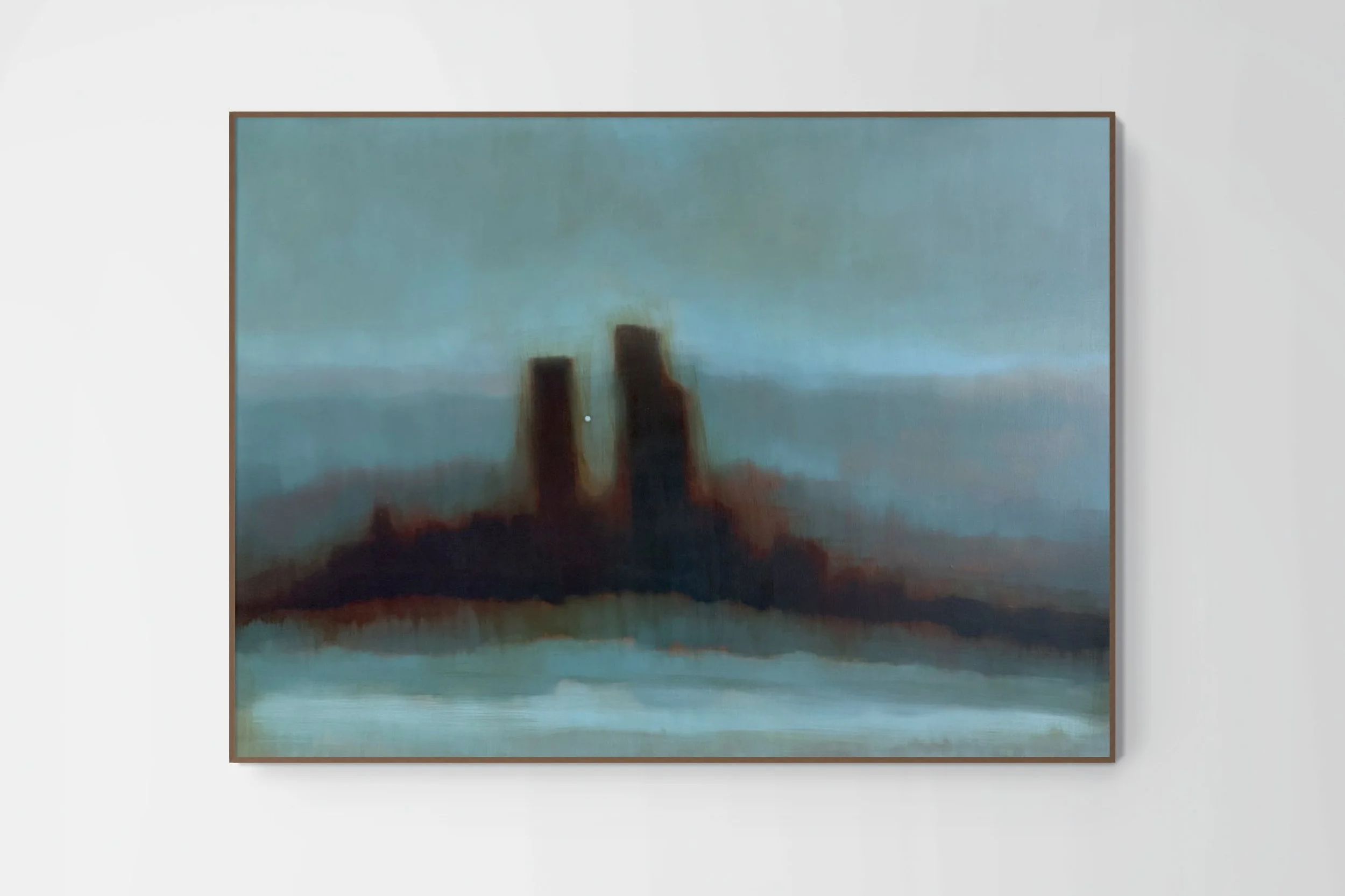
Blue Mists
oil on linen 100cm x 76cm
Inspired by the atmosphere of the ancient ruins of Corfe Castle, Dorset.
Nixon’s paintings often retain the essential structure of landscape: a horizon, a body of water, a distant hill or an isolated architectural form. Yet detail is deliberately withheld. Instead, place is reduced to tone, rhythm and the relationship between light and dark.
This restraint allows the paintings to remain open. They may suggest a remembered coastline, a lake at first light or the silhouette of a building seen through mist, but they resist becoming fixed geographical records. The viewer is given enough to enter the landscape, while space remains for their own memories and associations.
In Blue Mists, a dark structure rises from a low, shadowed landmass beneath a broad blue sky. Its softened edges make it feel less like a building carefully observed than an image slowly surfacing from memory. The cool expanse surrounding it creates a sense of distance and quiet, while the narrow distinction between land, water and sky lends the composition an almost dreamlike suspension.
Holding the Light revisits a similar silhouette through a markedly warmer atmosphere. Peach, ochre, muted green and deep brown move gradually across the surface, as though the landscape is absorbing the final light of evening. The solid form at its centre anchors the composition, yet even this appears vulnerable to the surrounding haze. The title captures a recurring tension within Nixon’s work: the wish to preserve a passing moment while recognising that it cannot remain unchanged.
Painting the threshold
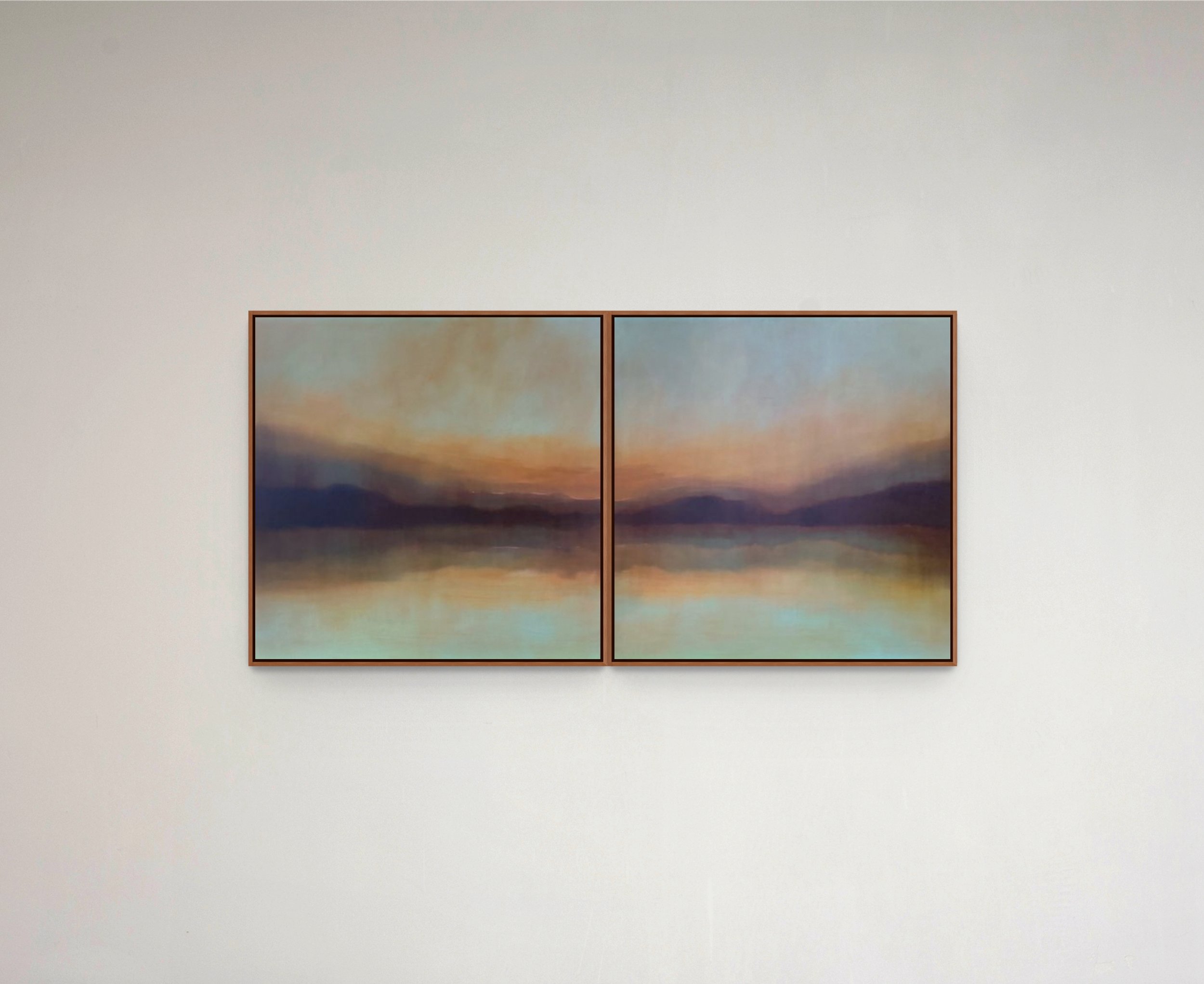
oil on linen
100 × 200cm
A diptych comprising of two 100 x 100cm canvases
Unframed but framing is available please get in touch to organise framing
Inspired by the view to the Purbecks from South Deep anchorage in Poole Harbour at sundown.
by Karina Nixon
Dawn and dusk are especially important within Nixon’s practice. These are threshold moments, neither entirely one thing nor another. Forms become indistinct, colours behave unexpectedly and the familiar world briefly loses its certainty.
Her diptych The Silence Where the Dreamer Hears reflects this sense of transition. Across the two panels, low hills and their reflections are held within bands of blue, violet, apricot and pale turquoise. The image is divided physically, yet the atmosphere continues across both canvases. This slight interruption slows the act of looking, encouraging the eye to travel from one panel to the other and to notice the subtle variations between them.
The title suggests that silence within these paintings is not an absence. It is a space in which something quieter can be perceived. Nixon’s landscapes invite a similar kind of attention. Their drama lies not in a pronounced gesture or narrative event, but in almost imperceptible changes of temperature, tone and light.
Colour built slowly
Nixon’s approach has been influenced by the American Tonalists, whose landscapes used closely related colours, softened edges and restrained compositions to create emotional atmosphere. In her own work, harmonious colour is gradually built through thin veils until the surface appears to glow from within.
This method gives the paintings both depth and ambiguity. Areas of colour seem to advance and recede without hard boundaries. A distant ridge might dissolve into the sky, while a reflection becomes almost indistinguishable from the light above it. The atmosphere is not applied around the landscape; it becomes the landscape.
Although apparently serene, these works are carefully controlled. Their simplicity depends upon delicate decisions about proportion, tonal balance and the point at which a form should remain visible or be allowed to disappear. Nixon’s paintings occupy the space between abstraction and representation, retaining the emotional familiarity of landscape while dispensing with much of its descriptive information.
A place for stillness
There is a quiet emotional pull to Nixon’s work. Her landscapes do not demand attention through scale or spectacle. Instead, they reward sustained looking, gradually revealing shifts that may not be immediately apparent.
This quality makes the paintings especially compelling within an interior. Their expanses of softly modulated colour bring depth and atmosphere to a room without overwhelming it. At the same time, the darker forms and carefully placed horizons give each composition sufficient presence to hold a space.
Nixon’s work has been exhibited across the UK, including Wells Art Contemporary, the Society of Women Artists at Mall Galleries, Tremenheere Gallery in Penzance and Blue Shop Gallery in London. Her training includes a BA in Art Education from Roehampton University, study at Sarum Studio Atelier of Fine Art and further development through programmes at the Newlyn School of Art.
Across her practice, however, the central concern remains remarkably focused: how paint might hold the atmosphere of something already passing. Her landscapes capture neither a precise location nor a single fixed instant. They offer instead the lingering sensation of light, distance and stillness after the place itself has begun to fade.